Article published in Forbes Portugal on July 14, 2026
There is an idea that spans decades of business management and that, despite everything the world has changed in the meantime, remains as relevant as ever. It is called kaizen, it comes from Japanese, and it literally means change for the better.
But translation, however accurate, is not enough to explain what lies behind this concept. Kaizen is not a management technique or a methodology with an instruction manual. It is, above all, a way of approaching work and life. A conviction that the current state of things is always provisional and that there is always something, however small, that can be improved.
But translation, however accurate, is not enough to explain what lies behind this concept. Kaizen is not a management technique or a methodology with an instruction manual. It is, above all, a way of approaching work and life. A conviction that the current state of things is always provisional and that there is always something, however small, that can be improved.
Anyone who leads a technology company is well aware of the pressure of speed. The sector demands quick answers, frequent releases and constant adaptation. In this environment, it is easy to confuse motion with progress. It is easy to accumulate features, expand teams and multiply processes without ever stopping to ask whether what we are building is, in fact, better than what existed before. Kaizen requires precisely that pause. Not to slow down, but to look honestly at what is being done and at what could be done differently.
The philosophy was born in postwar Japan, in a context of scarce resources and an urgent need for industrial reconstruction. It was Toyota that made it famous, by turning it into the foundation of a production system that has been studied and imitated around the world. But what many organizations have discovered, often at a cost, is that copying the tools without internalizing the philosophy does not produce sustainable results.
Kaizen does not work as a program that can be installed in an afternoon. It works as a culture that is cultivated day after day, with the genuine participation of everyone who is part of an organization.
João Antunes
Board Member INCENTEA
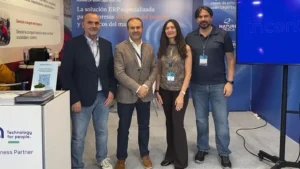
INCENTEA and CEGID attended Conxemar 2026, presenting Seafood DR.
INCENTEA strengthens its expansion in Spain with the integration of Catalan company I2T