
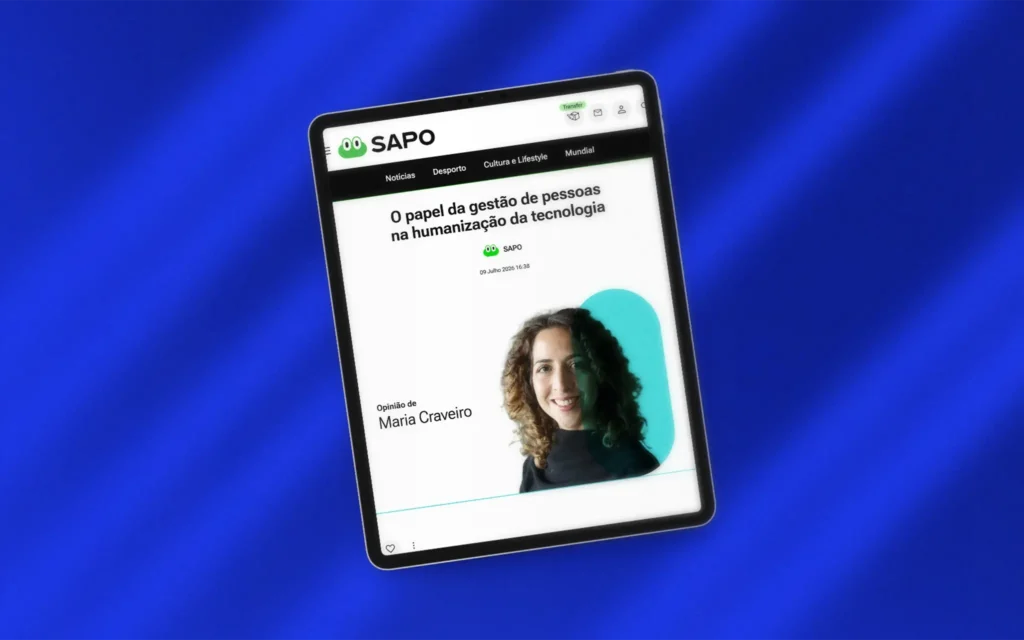
Article written for Sapo, July 9, 2026
Technology has clear benefits, but there is a question we do not always ask: what might we lose when we choose to use technology?
We live in an era in which technology has gone from being an option to being a condition for competitiveness. Automation, collaborative systems, process digitalization and artificial intelligence are now part of everyday life in organizations.
The benefits are clear. Technology brings efficiency, speed, access to data and decision-making capability. It helps reduce repetitive tasks, systematize processes and free up time for higher-value activities.
But there is a question we do not always ask: what might we lose when we choose to use technology?
This is not a reflection against innovation. Technology is a lever of progress. The problem is not technology itself, but how we decide to use it.
In many digital transformation processes, the pattern repeats: a need is identified, a solution is sought, the tool is implemented, and everything is expected to work better. But that is not always what happens. How many solutions that made sense on paper ended up complicating the work? How many promises of efficiency generated noise, resistance or distance between people?
Perhaps it is because, at times, we automate without deeply understanding the work in question. We strip away context, nuance and the ability to handle exceptions. We confuse speed with improvement, forgetting that doing something faster does not mean doing it better.
It is not technology that dehumanizes organizations. What can dehumanize them are poorly considered decisions: what to automate, who to involve, what impacts to anticipate and which human dimensions to preserve.
This is precisely where people management plays an essential role. If we maintain that Human Resources is a strategic function, it cannot be left out of these choices. A new tool is not merely a technical or top-management decision. It changes people’s daily experience: how they work, communicate, collaborate and relate to the organization.
For that reason, people management should see itself as a co-author of technological transformation, with three responsibilities.
The first is to put people at the center, assessing not only what the technology makes possible, but also its impact on employees’ day-to-day work. Before digitalizing or automating, it is important to ask why, how and with what impact.
The second is to create contexts of trust. Resistance to change is often born of uncertainty rather than an inability to adapt. It is up to people management to create space for communication, listening and participation.
ANGOTIC 2026

22nd INCENTEA Convention


